


Cavern Diving Versus Cave Diving Explained
A cenote entrance can feel like an invitation: sunlight pouring through jungle leaves, clear water revealing limestone walls, and a passage that seems close enough to touch. But cavern diving versus cave diving is not a question of how beautiful the route looks. It is a question of whether you can see a direct path to daylight, what happens when visibility disappears, and whether your training truly matches the environment.
For divers visiting Mexico's Caribbean coast, understanding that line is essential. Cenotes offer some of the planet's most extraordinary underwater scenery, but they also demand respect. The right progression turns curiosity into skill. Skipping steps turns a breathtaking place into an unforgiving one.
Cavern Diving Versus Cave Diving: The Core Difference
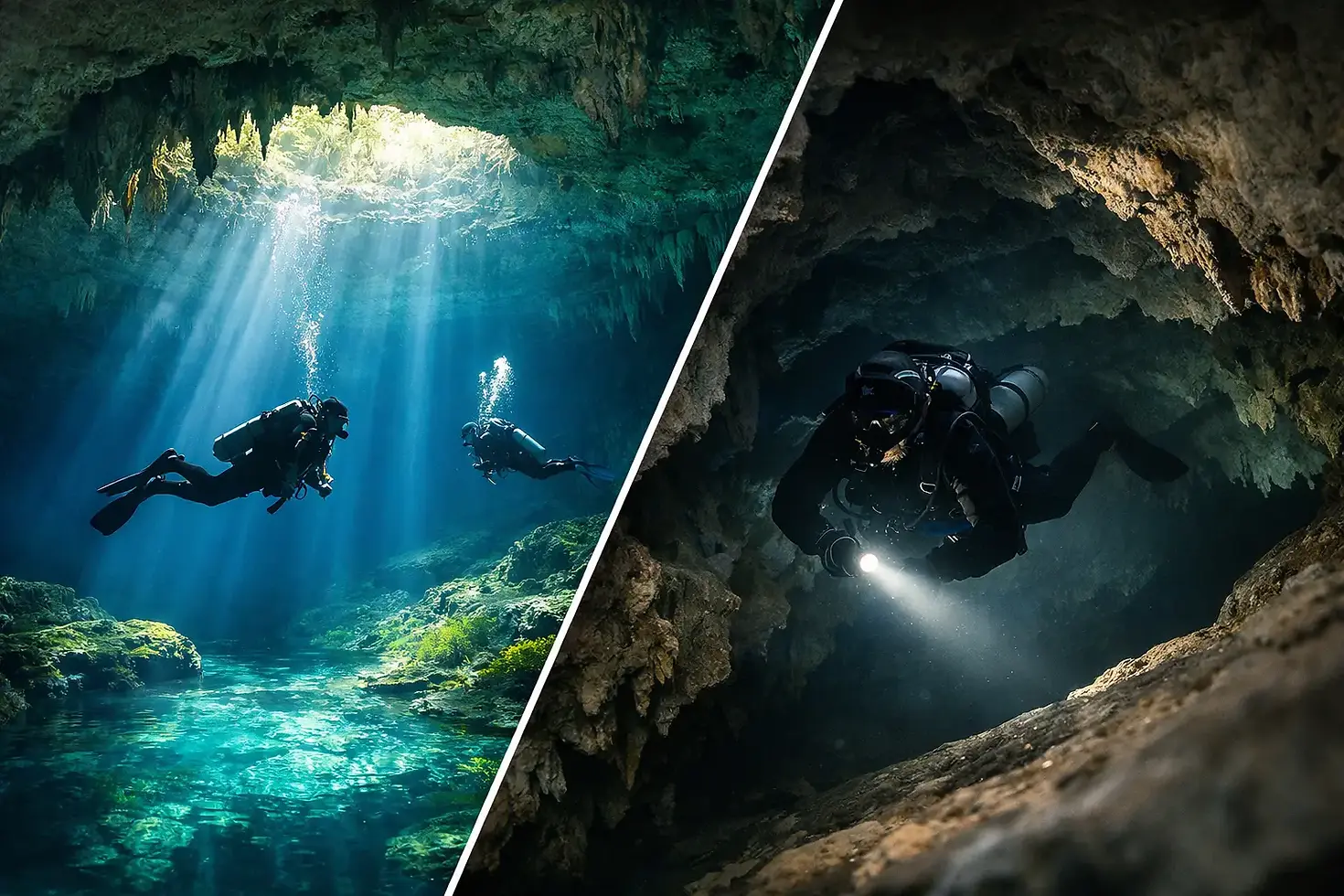
The simplest distinction is daylight. In a cavern dive, divers remain within the daylight zone. There must be a visible, unobstructed route back to open water, even when the team is well inside the entrance area. You are under an overhead, but the outside world remains visually available.
In cave diving, that direct view of daylight is gone. A cave diver may travel through rooms, restrictions, passages, and junctions where the only reliable way out is a continuous guideline, sound judgment, and practiced team procedures. The environment has changed from a limited overhead excursion to a true penetration dive.
That difference changes everything. A lost mask, a damaged light, a silt-out, an equipment failure, or a moment of disorientation can be managed very differently when daylight is visible. Inside a cave, the exit is not found by swimming upward or following natural light. It is found by following the line, maintaining control, and executing skills that have been trained until they are calm under pressure.
A Cavern Is Still an Overhead Environment
A common mistake is treating cavern diving as open-water diving with a roof. It is not. The surface is blocked above you, sediment can reduce visibility quickly, and a narrow exit can make a small problem feel much larger.
Cavern training introduces the disciplines that make overhead exploration possible: awareness of the entrance and exit, buoyancy control, propulsion that protects fragile formations and visibility, light communication, line awareness, gas planning, and team positioning. These skills are not decoration. They create the margin that lets divers enjoy the experience without damaging the cave or losing control of the dive.
Many guided cavern experiences in the Yucatán are designed for qualified recreational divers under conservative limits. The exact limits vary by training agency, site conditions, and local procedures, but the principle remains consistent: stay close enough to the entrance that natural light and a straightforward exit are always present.
A cavern dive can be intensely memorable without becoming a cave dive. Shafts of light, haloclines, fossils, sculpted limestone, and the quiet of clear freshwater can create a powerful connection between mind, body, and place. The goal is not to push farther. The goal is to experience the cavern with control.
What Changes When You Enter a Cave?
Cave diving requires a different level of commitment because the environment removes easy options. The diver must be prepared for a return journey through the same overhead system, potentially in darkness, zero visibility, or with a teammate managing a problem.
This is why cave training is progressive. Divers develop the ability to run and follow a guideline correctly, manage intersections and directional markers, share gas while exiting, handle lost-line and lost-diver scenarios, maintain trim in confined spaces, and make disciplined turn decisions before a problem develops. Cave divers also learn to read a system rather than simply follow a path. Flow, depth changes, passage size, line placement, sediment, and gas consumption all affect whether a route is appropriate that day.
Equipment reflects that reality. Cave divers use redundant life-support and navigation equipment, including multiple lights and independent gas sources appropriate to the configuration and plan. Gear is streamlined to reduce snag hazards, protect the line, and allow the diver to move efficiently through restrictions. Configuration alone does not make someone cave-ready, but it supports the procedures learned in proper training.
Cave diving also demands a stronger decision-making mindset. A successful cave dive is often uneventful precisely because the team chooses not to enter a passage that is too tight, too silty, too deep, too complex, or simply outside the plan.
Training Is Not a Label
A recreational certification, even one earned by an experienced ocean diver, does not qualify someone for cave penetration. Strong open-water skills matter, but they are a foundation, not a substitute for overhead training.
The journey often begins with buoyancy and trim refinement, followed by cavern training, then introductory cave and full cave instruction. Some divers take longer between stages, building comfort through practice and guided experience. Others arrive with technical diving experience and progress efficiently. Neither timeline is automatically better. The right pace depends on skill consistency, awareness, fitness, attitude, and the ability to receive feedback without ego.
A quality instructor will not measure readiness by the number of dives in your logbook alone. They will watch how you hover, how you communicate, how you respond when a task becomes uncomfortable, and whether your fundamentals remain stable while your attention is divided. In overhead environments, small habits become major outcomes.
Light Zone approaches this pathway as a connected development process, from recreational foundations to cavern, cave, technical, CCR, and DPV disciplines. For traveling divers, that continuity matters. You are not collecting isolated certifications. You are building the judgment to explore more demanding environments responsibly.
Why Mexico's Cenotes Make the Difference Visible
The cenotes near Tulum and Playa del Carmen make the distinction between cavern and cave especially clear. At many entrances, the daylight zone is visually dramatic: bright blue light frames limestone formations while the jungle entrance remains in view. Move beyond that zone, however, and the character of the system changes quickly.
The water may remain exceptionally clear, but clarity is not the same as safety. A crystal-clear cave can still be a maze of passages with no direct ascent. A sudden change in a diver's fin technique can still lift fine sediment. A line can still be missed if procedures are weak. Beautiful conditions often make disciplined decisions look easy, which is exactly why divers must understand what supports them.
Cenotes are also living geological environments. Delicate formations can take thousands of years to develop, and careless contact can cause permanent damage. Excellent buoyancy is not only about personal safety. It is a form of respect for the cave and for every diver who hopes to see it after you.
Choosing the Right Experience for Your Current Level
If you are an open-water diver drawn to cenotes, a professionally guided cavern experience may be the right first step. You can encounter the magic of an overhead environment while remaining in daylight and within conservative procedures. Come prepared to listen carefully, move slowly, and let the guide set the pace.
If you have cavern training and feel called to go beyond the visible entrance, cave training is the next conversation, not a shortcut. Ask what prerequisites apply, how skills are evaluated, how much time is spent practicing emergencies, and what happens if you need more development before advancing. The best answer is sometimes, “not yet.” That is not a setback. It is professional care.
For certified cave divers, site selection still matters. A familiar certification level does not automatically make every cave, route, or condition suitable. Flow can change, water levels can shift, and a route that fits one team's experience may be a poor choice for another. Good cave divers retain the humility to turn a dive when the conditions or the team do not align.
The Real Reward Is Control
Cavern and cave diving both offer access to places most people will never see. One lets you stand at the threshold, surrounded by light and limestone. The other asks you to travel farther into silence, guided by training, teamwork, and a line that leads home.
Neither is inherently more valuable. A cavern dive can be the perfect experience for a recreational diver, while a cave dive can become a profound pursuit for someone willing to earn every stage of the journey. Let the environment set the standard, let your skills determine the next step, and let the unknown remain something you approach with patience.


Comments